FROM THE NEWSPAPERS - 1928 - Gastro Epidemic at Brown Coal Mine - Dr J M Andrew
1928 - A CRISIS AT THE BROWN COAL MINE SETTLEMENT
Life was difficult for many families in and around Yallourn in earlier times as can be seen from the following newspaper article.
The story was published in ‘The Argus’ in 1928; and told of a series of deaths caused by an outbreak of gastro-enteritis at the Brown Coal Mine settlement.
The epidemic at the Brown Coal Mine settlement gained widespread coverage throughout the nation; and one newspaper (‘Advocate’-Burnie, Tasmania) attracted great attention when it printed that the deaths at the BCM had been caused by meningitis.
The extract described the actions taken by the medical authorities during the emergency; and several paragraphs highlighted the responsibilities of Yallourn’s Dr James Moore Andrew during the harrowing time in local history.
The description of the workers’ homes at the Brown Coal Mine, as outlined by Dr Harris in his report to the Health Commission, gives readers an insight into the unforgiving living conditions of the workers of that era.
Another brief news item (positioned below the main article) carried the headline: ‘Another Child Taken to Hospital’. The article implied that the epidemic had not run its full course; and that the anxieties, of residents at the Brown Coal Mine, had not been quelled.

March 7th 1928 ‘THE ARGUS’ Page : 27

YALLOURN EPIDEMIC.
FOOD CONTAMINATION
HEALTH COMMISSION REPORTS.
"Houses Unfit for Habitation."
At the end of last month an epidemic, believed at the time to be meningitis occurred at the Brown Coal Mine settlement, near the State Electricity Commission’s works at Yallourn and seven died.
Following the epidemic the Health Commission requested the district health Officer at Sale (Dr. H.E. Harris) and the medical officer of health at Yallourn (Dr. J.M. Andrew) to furnish reports regarding the outbreaks. These were received yesterday at a meeting of the Health Commission.
The cause of the epidemic has now been established as gastro-enteritis not meningitis. Dr Harris described the conditions under which some the State Electricity Commission’s employees live with their families at the Brown Coal Mine Settlement.
In his report Dr Andrew said:-
‘On February 9 there occurred the first case of a serious epidemic of acute gastro-enteritis among the young children and infants at the Brown Coal Mine. Since then there have been 15 cases. It is very unfortunate that on February 28th, this outbreak was erroneously reported as an epidemic of meningitis.
There has been no meningitis among the cases in this area. The cause of the epidemic was, in my opinion, the moist steamy weather, the large number of flies prevalent this summer, improper means of preventing contamination of food, and especially of milk in the homes by flies and the failure of parents to realise the necessity of reporting the cases for treatment immediately the symptoms occurred. There is every evidence that the epidemic is now practically at an end, as no fresh cases have been reported in the last six days.’

Dr Harris reported as follows:-
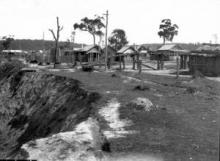
I visited Yallourn on March 1 to investigate the reported serious epidemic of meningitis there. The Brown Coal township is built on high ground to the north of the Latrobe River. The town has never been laid out in any order, people just building their homes where it happened to suit them best.
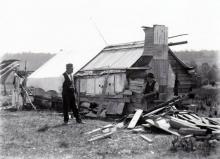
The place is thus a confused jumble of dwellings with tracks and streets running between them. The dwellings are a very mixed type, some being bark huts, others being made of wood slabs and palings. Those of more recent origin are constructed of weatherboards, and a few of fibro-cement sheets.
In addition the old types of homes have been enlarged as necessity arose, with rooms of galvanised iron or even petrol tins. Approximately 40 per cent to 50 per cent of the dwellings in this area are not fit for human habitation. Many of the houses have only two or three rooms and some only one. Dr Andrew pointed out to me the house in which the cases had developed, and they were all of the type described.
The assistant general superintendent of the State Electricity Commission (Mr Dixon) informed me that the work was gradually being stopped at this mine and he expected that within 12 months there would be a much smaller population residing there. Dr Andrew also informed me that every year there is an outbreak of gastro-enteritis at this township. It has been milder in the last two years but this year the outbreak was very sudden and the infection apparently of a very virulent kind.
I am of the opinion that the causes of the outbreak were those mentioned by Dr Andrew in his report. The main contributing factor was, however, the extremely unsanitary conditions at the township. I intend to make a detailed sanitary survey of this area.

The chairman (Dr. Robertson) remarked that, although the Health Commission had power to compel a municipal council to condemn houses considered unfit for human habitation it might find it difficult to apply such regulations to buildings at the Brown Coal Mine ( which is in the Shire of Narracan) because the whole district was practically controlled by the Electricity Commission.
The commission decided that before discussing the matter fully it would await a further report from Dr Harris.
Another Child Taken to Hospital
Another case of gastro-enteritis has occurred at Yallourn. The victim, a child aged I8 months, lived in the settlement near the old brown coal field. The patient has been removed to hospital.

FOOTNOTES

1. The news of the seven deaths at the Brown Coal Mine settlement sent a wave of fear throughout Australian mining communities. The story was published in West Australia (e.g. ‘Great Southern Herald’), Queensland (‘Brisbane Courier’), Tasmania (‘The Mercury’) and also in NSW (‘The Sydney Morning Herald’). Miners in distant locations would have been extremely interested in the events at the Brown Coal Mine.

2. The reports regarding the calamity varied from place to pace. For example, a Rockhampton newspaper (‘The Morning Bulletin’: May 2nd 1928) stated that nine children had died…
“Following the epidemic of gastro-enteritis, which occurred at the State Electricity Commission's brown coal mine, Yallourn, in February, as the result of which nine children died, a report has been received by the commission, attributing the cause of the outbreak to the extremely unsanitary conditions prevailing in the township. Investigations revealed a shocking state of affairs. Many houses were described as unfit for habitation and recommended to be condemned. Alterations were advocated to other buildings. The matter will he considered by the health commission.” Page: 9
3. The widespread reporting of the epidemic would have placed further pressure on the Victorian health authorities and an incredible strain on Yallourn’s only Medical Officer Dr Andrew.

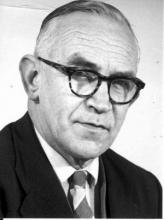
4. Dr James Moore Andrew (born:1899) had arrived in Yallourn in 1926. He was chosen for the position of Resident Medical Officer of Yallourn from 19 other candidates.

5. Dr Andrew took over the medical duties and responsibilities of Dr Hugh Mitchell (who resided at Morwell). Dr Mitchell was the first doctor at the mining camps in those early days of settlement. An article regarding Dr. Mitchell’s remarkable work as the M.O in the Yallourn camps is also posted on this website.

6. As is well known by former residents of Yallourn, Dr Andrew was a physician noted for his boundless energy and genuine concern for the community. Dr Andrew was an heroic character in the story of Yallourn; and he would have approached the epidemic in ‘head-on’ fashion and with the utmost diligence.

7. It should be remembered that the calamity occurred more than 85 years ago; and the emergency would have severely tested Dr Andrew’s knowledge, resources and time. Further articles regarding Dr Andrew and his life in Yallourn can be found on this website… Type: ‘Dr Andrew’ in to the search field (top right hand corner of the screen and press: Enter.

8. The symptoms of gastro-enteritis include vomiting, diarrhoea, high temperatures (fever) and stomach pain; and it is not hard to imagine how difficult it would have been to treat such cases at home in 1928 (eg with small huts with large families, poor sanitation, lack of hot running water and effective disinfectants).

9. The hospitalisation of sick residents of the camps was a logistical challenge in terms of access to vehicles and distance. The Yallourn Hospital did not open until January 1929 and, up until that time, patients who required emergency treatment (eg the sick children as above) were conveyed to public hospitals at either Warragul or Sale Hospital. Note: It is known that a one-vehicle ambulance service began operations in Yallourn in October 1924.

10. Modern-day management of gastro-enteritis demands the provision of intravenous fluids to patients. In comparison, with the above story, the risk of death through dehydration and sepsis these days has been greatly reduced.

11. For further information regarding the life and times in the mining camps an excellent reference is Kath Ringin’s book: ‘The Old Brown Coal Mine.’

12. A recent illustrated book that deals with life in the camps in later years was written by Josef Sestokas in 2010 and is entitled ‘Welcome to Little Europe: Displaced Persons and the North Camp’…
“Between 1947 and 1951, Australia received over 170,000 displaced persons (DPs) from war-ravaged Europe. The author's father was aboard the first DP transport to arrive in Australia. From Bonegilla he was sent to work for the State Electricity Commission of Victoria (SECV) at Yallourn, along with 47 other Lithuanians, Latvians and Estonians. They lived in a hell-hole, the North Camp at Yallourn North, new Australians amongst hundreds of old Australians.” Source: Summary - National Library of Australia”

13. Readers may be interested to know that the Brown Coal Mine became known as Yallourn North in 1947 …
“The small settlement known for 60 years as Brown Coal Mine will be called Yallourn North as from August 1. The township is on the north side of the Latrobe River, about two miles from Yallourn. The open cut, near the town, which is supplying raw brown coal for industrial use, will be known as the Yallourn North open cut.” ‘The Argus’ July 25th 1947 Page: 4

____________________________________________________
The above story is part of an on-going project regarding the history of Yallourn. The story was researched and written by Roger Spaull and presented and posted by Julie George for the Virtual Yallourn website in August 2017.
The above article from ‘The Argus’ (Melbourne) has been faithfully reproduced. The only amendments to the original copy are the font style, font size and spacing, so as to enhance the article for purposes of posting on the Virtual Yallourn website.
IMAGES OF YALLOURN - 1951 - Yallourn Soccer Club

Year (OLD)
1951
Relationship

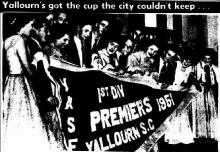
Yallourn’s got the cup the city couldn't keep ...and they're the first to take it up-country. Yallourn, Tuesday Victory Ball night at St. John's Hall last night! Yallourn Soccer Club was celebrating its Victorian Junior Amateur Football Association premiership. They're the first country team lo carry the cup away from Melbourne.

SOURCE : NLA :23086403 ‘THE ARGUS’ WEDNESDAY 17th OCTOBER 1951 PAGE 5

FROM THE NEWSPAPERS - 1934 - Bill Fleming and the Yallourn Band and Orchestral Society

MORWELL ADVERTISER 7th JUNE 1934 PAGE 9

INTRODUCTION:

The following news article, regarding the Annual General Meeting of the Yallourn & District Band, was published in the ‘Morwell Advertiser’ in June 1934 and reported on the highlights, activities and financial situation of the band during that year.

The Yallourn Band is an absorbing story in the history of the town; and this website and various other texts refer to the importance of the band throughout the six decades of Yallourn’s existence. The origins of the Y&DB are not exactly clear but it is believed that several local workers, with a love of music, contemplated forming a band as early as 1921. The idea took hold and with the patronage of Sir John Monash and recruitment of other enthusiastic musicians the band became a reality, flourished and, in time, gained a reputation as ‘one of the best’ in Victoria.

While Charles Turner is the most celebrated of all Yallourn bandsmen, the story which is included in this article centres on another of the other great contributors to the musical culture of the town of Yallourn - Mr Bill Fleming.

Bill Fleming was an extraordinary character and this story highlights his dedicated contribution to the Yallourn music scene and his experiences as a soldier and a POW during WW2.
________________________________________________________________

THE NEWSPAPER ARTICLE :

JUNE 7th 1934 MORWELL ADVERTISER PAGE : 9

Yallourn and District Band.

At the Annual Meeting held last Tuesday evening, the following office bearers were elected:
• President: C. Boehm and G. Dickson Brown.
• Secretary: N. P. Bolger.
• Asst. Secretary: W. Fleming.
• Committee representing the public: P. Harry, G. N. Bedford, E. Garret, H. Lynch. J. E. Turvey.
• Trustees: T. Hill and W. M. McRitchie.
• Auditors: J. Cullen and T. E. McGowan.
• V.B.L. Representative: H. A. L. Binder.
• The Committee representing the bandsmen: A. L. Williams, A. Forbes, R. Gould, P. Cameron and R. C. Wiggins.

The following report was submitted to the meeting:
Several changes in the playing personnel of the Band took place but the Band has been able to keep up to full playing strength. Young players are being trained and encouraged, and it is hoped that in the near future most of the vacancies which occur will be filled from the ranks of these young players.

The services rendered by Mr J. C. Turner as Bandsmaster have been most satisfactory, and he has devoted a great amount of time to the training of the bandsmen. He has kept abreast of the times in providing and teaching suitable musical compositions which have been appreciated during the recitals given by the Band at the rotunda.

Appreciation of the services rendered by Mr Williams, the Band Sergeant, who has been the principal coach of the young aspirants for positions in the Band, was expressed by the Committee; also to Mr J. Amos, the Drum Major, whose services have contributed in no small manner in bringing the Band up to such a high standard in the drill and marching section. The bandsmen's interests have also been well looked after by Mr H. A. L. Binder, who is the Band's delegate to the Victorian Bands League.

To the playing members of the Band the public of Yallourn owe a measure of thanks for the self-sacrificing manner in which they have devoted their leisure time to practice in order that they might provide enjoyment for their fellow citizens.

During the past year the Band has competed in one band contest, which was that held at South Street, Ballarat, where they succeeded in gaining second place. The general opinion of bands men who attended this competition is that the playing of the Yallourn Band reached the highest standard it has ever attained. Several soloists also competed at this contest, but only one succeeded in catching the Judge's eye.
Early in the year the Band held a local Solo Competition. On the 24th September last the Yallourn Band took part in the Massed Bands performance on the Melbourne Cricket Ground, and created a very fine impression, whilst marching through the streets, and on the ground. Whilst in Melbourne for the Massed Bands Recital, the Band broadcast a programme from Station 3AR, which was commended by the Broadcasting Company, and well received by listeners.

Later in the year the Band was again ‘on the air’ during a broadcast description of the Commission's workings at Yallourn. In addition to recitals given at the Yallourn rotunda and the Hospital, several performances were given in neighbouring towns within an area extending from Warragul to Bairnsdale.

For the year ended May 29th, 1934, the finances of the Band were maintained satisfactorily. Receipts from all sources amounted to £307/4/3, whilst expenditure totalled £426/3/11, leaving a debit balance of £118/19/8. The balance sheet as at 29/5/1934, reveals a surplus of assets over liabilities of £404/15/1.

The members of the social committee were commended on their efforts during the past twelve months. To those members who are actually interested in band affairs it is quite apparent that without the efforts of the social committee the band could not retain the standard which it has attained.

The committee expressed its appreciation of the services rendered by the honorary auditors, Messrs J. Cullen and H. E. McGowan. The financial success of Band recitals has been facilitated considerably by the Press, to whom the committee extended thanks for publishing programmes and giving publicity to Band affairs generally.

It has been the desire of the committee to establish a suitable building in which the Band could practice, and the bandsmen could hold their own social functions. With this object in view the General Superintendent was approached about the middle of last year with a complete scheme, together with a suggestion that the material be supplied by the Commission and the labour provided by the bandsmen, but to date no definite reply has been received to this proposal.

The public of Yallourn were thanked for their continued practical and financial support which at all times has been given generously, and with an earnest desire to elevate the Band to a status worthy of the town.
_________________________________________________________________________

BILL FLEMING AND THE EARLY YEARS

William James Fleming was born in Bulwell, a suburb of Nottingham, England in August 1906. He was the son of William James Fleming Sr, a coal miner, and Emma Fleming. Bill had a brother Ted, and sisters Elsie, Nell and Doris, all of whom except Elsie eventually migrated to Australia, settling in Yallourn and surrounds.

Bill left school in Bulwell at the age of 13 and began work at a colliery in the mines. He learnt to play the cornet at an early age and played with the Hucknall Excelsior Band, a champion band in the English Midlands, and began to develop what was to become a life-long passion for bands and music.

In 1928 Bill migrated to Australia to join his older brother Ted, and began work in the coal mines at Wonthaggi. They lived in Korumburra and within months he was appointed to the position of bandmaster of the Korumburra Brass Band. They were soon joined by the rest of the family, although sister Elsie married in 1921 and remained in England. In 1929 Bill successfully applied for the position of Assistant Bandmaster in the newly formed Yallourn Band, and moved to Yallourn. He settled into the South Camp, and began work as a labourer before becoming a greaser and fireman at the Yallourn Briquette Factory. Ted soon joined him in Yallourn and worked as a bricklayer with the SEC. Unlike Bill, Ted had no active interest in music but was a talented golfer, winning the Yallourn Golf Club championship in 1935, 1936 and 1937 before suffering a back injury and subsequently leaving Yallourn.

Bill met Mary Nancarrow who worked in the general store and they married in 1934. They moved to a house in Southway to start their married life, which was to continue until Mary’s passing in 1980.

Bill continued to work at the Briquette Factory for the rest of his working life, punctuated by his service in WW2. He obtained a position on staff in the Briquette offices as Operations Records Officer in 1948, became a Technical Services Officer in 1959 and continued until the close of the factory in 1971. Although Bill was due for retirement he was employed to work for some months after the factory closure to assist with the personnel dispersion and ultimate closure of the factory. He found working alone in the factory to be quite different and sad in many ways, but was happy to continue his 43 year association for a little longer.

BILL FLEMING
& THE YALLOURN BAND

The background to the formation of the Yallourn Band is not unlike those of the colliery bands in the mining villages of England during the 19th century. From the earliest days of
Yallourn, the SECV commissioners appreciated the importance of music in the lives of workers and encouraged the formation of a town band with both moral support and direct financial aid for the purchase of instruments. The formation of the Yallourn and District Band was mentioned in an article in ‘The Sydney Morning Herald’ in August 2014…
In Victoria’s southeast, the State Coal Mine in Wonthaggi was the springboard for the Union Band, which merged with the Wonthaggi Town Band in 1935. In 1922, workers at the State Electricity Commission coalmines in the Latrobe Valley formed the Yallourn and District Band. The state utility contributed £400 to help buy instruments and uniforms. ‘The SMH’ August 20th 2014.
The inaugural Yallourn Band committee meeting was held in November 1925 and the elected office bearers were listed as: F.E. Morton, H.I. Roberts and J. Turvey.

Bill Fleming’s name was first mentioned in this research sometime in 1929. He was 23 years of age when he took his place in the band. In that period, there were at least five cornet players… Bill Reid, Alf Welfare, Bill Daniels, Frank Schneider and Bill Fleming.

Bill loved music and joining the band was a natural progression in his life. Not only was Bill an adept and versatile musician but, as shown in the newspaper article above, he was an active member of the band committee from the earliest times.....

TO READ THE COMPLETE ARTICLE, PLEASE CLICK ON TITLE AT THE TOP OF THIS ARTICLE, THEN SCROLL TO THE BOTTOM AND BELOW THE PHOTOS, YOU WILL SEE PDF DOCUMENT TO OPEN. (If you have any difficulty with this, please contact julie@yallourn.org.)

pdf document

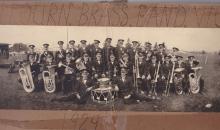
Yallourn Brass Band - 1929

Year (OLD)
1929
Relationship

Yallourn Brass Band 1929 - names of bandsmen:

Top row: L. Trengrove, W. Daniels, W. Fleming, J. Smith, K. Shepherd, W. Reed, A. Welfare, F. Schneider, A. Risely(?), E. Sousa, A. Wiggins, J. White
Front row: K. Smith, J. Arnold, R. Wiggins, R. Douglas, J. Amos, V. McMahon, J. Turvey, P. Cameron, A. O'Brien, R. Gould, G. Roberts, P. Noonan
Drummers: P. Hyland, W. Kite

Source: Ian Fleming

1941 Yallourn State School YSS

School
Yallourn Primary School
Year
1941
Grade/Form
0

Back Row: Colin Harvey, Eric McKinstray, Hayden Hutton, John Graham, Graham Harkins, George Fulwood, ? Reid, Ian Terrill, Norman Aldred
2nd Back Row: Mickey Ross, Ian Smith, Max Pritchett, Paulene White, Ruth Gill, Marj Smith, Margaret Turner, Ian Curtis, Jeff Madden, Norman Foley
Middle Row: Gloria Knight, Joan Scott, Barb Buller, Bev Jones, Marg Prestidge, Jenifer Grant, Lorraine Douglas, Avril Scanlon, Dawn Doxin, Dot Hansen
2nd Front Row: Nancy Warren, Audrey Savige, Brenda Metcalf, Elaine Griffiths, Bev Smith, Doreen Kitney, Pam McPhee, Enid Davis, Elaine Broberg, ? , Barbara Bingham

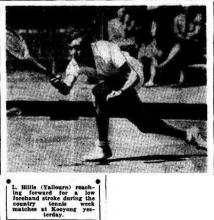
IMAGES OF YALLOURN - 1941 - L Hillis Tennis

Year (OLD)
1941
Relationship

L. Hillis ( Yallourn) reaching forward for a low forehand stroke during the country week matches at Kooyong yesterday.

SOURCE: NLA 205298353 ‘THE AGE’ TUESDAY MAY 4th 1941 PAGE:10

FROM THE NEWSPAPERS - 1954 - World Champion Lindrum Visits Yallourn

A WORLD CHAMPION VISITS YALLOURN
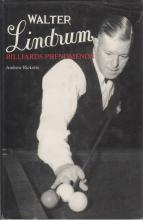
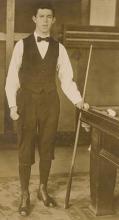
One of the most eagerly anticipated events in Yallourn in 1954 was the visit by the world billiards champion Walter Lindrum. It may difficult for younger readers to appreciate but, in those times, billiards was an exceedingly popular sport throughout Australia.
The following article was published in 1954; and it reported that the Yallourn War Memorial Appeal Committee had arranged for Walter Lindrum to give a series of exhibition games at the St John’s Hall.
The footnotes to this story also refer to Walter’s brother, Fred, who had visited Yallourn in 1931.

April 10th 1954
‘MORWELL ADVERTISER’ - Page 4
Lindrum Helps Yallourn
War Memorial Appeal
World Champion billiardist, Walter Lindrum, has most generously offered to help the current Yallourn War Memorial Appeal by giving exhibitions of billiards, snooker and trick shots at St. John's Hall, Yallourn, on April 21st and 22nd, entirely free of any expense to the Memorial Committee.
There will be two sessions 'each day at 2 p.m. and 8 p.m., an outstanding feature of which will be lecturettes on billiards and snooker by Lindrum.
During the Empire tournament in London, Lindrum made breaks of 4,137, 3,262 besides making 28 breaks of over 2,000 and 700 breaks of over 1,000 during his career. In snooker his best breaks are 139, 134, 129, 127, 118 and 113, and 12 others of over 100.
He is the holder of the English, Irish, Scottish, American, Canadian, South African, Indian, Australian and all World's records.
The committee has set the price of 5/ per session, which it does not consider excessive for two hours exhibition and lecturette by the greatest billiardist of all time.
Work Commenced on Memorial
With to date £530 subscribed to the appeal, the project is taking shape and a full scale model has been erected in the Town Square. Following the committee's suggestions of certain modifications to the architects, working drawings are being prepared and the stone has been ordered. A decision has also been made as to the inscription, a few simple works in keeping with the forthrightness of the design.
FOOTNOTES
A few weeks later, the same newspaper reported that Walter Lindrum’s exhibition at Yallourn had been an overwhelming success …
“The Yallourn War Memorial Appeal will benefit to the extent of over £450 as the result of the billiards exhibitions given last week by Walter Lindrum. His show was voted the best one man entertainment ever to visit Yallourn.” ‘Morwell Advertiser’ May 1st 1954.
2. On the basis of 5/- (shillings) per person admittance fee, it appears that about 1,800 people attended the exhibition in Yallourn. Note: £450.0.0 (pounds) is equivalent to approximately $14,700 today and such an amount in 1954 would have been a substantial contribution to the War Memorial Appeal.
3. Walter Lindrum (born 1898) was the son of Frederick William Lindrum. The Lindrum family members not only played billiards, at a most proficient level, but enthusiastically promoted the game throughout the world. Walter’s older brother, Fred, was a brilliant billiardist and had won the Australian Billiards Championship in1909.
4. It must have been a huge thrill for the people of Yallourn to see Walter in action. Walter held super star status throughout Australia; and he was once called the ‘Bradman of Billiards’. According to ‘The Age’ writer Greg Baum …
“1931, Lindrum gave a billiards exhibition for the King and other members of the Royal Family at Buckingham Palace. King George V presented Lindrum with a pair of gold and enamel cuff links bearing the royal monogram. These formed part of Lindrum's essential attire for the remainder of his playing career, and he wore them daily for the rest of his life.”
5. Walter was inducted into the Australian Sporting Hall of Fame and was also featured on an Australian postage stamp in 1981. His portrait hangs in the National Portrait Gallery of Australia; and he was awarded an MBE in 1951 and OBE in 1958.
6. Walter Lindrum died in 1960 at the age of 61 years. His death was somewhat of a mystery and doubt still exists today as to the exact cause of his demise…
“On 30 July 1960, at the age of 61, Walter Lindrum suddenly became ill and died while on holiday in Surfers Paradise, Queensland. The cause of death was officially listed as heart failure, but it has alternatively been suggested that he died as a result of food poisoning from a steak and kidney pie.” Melbourne Daily Website.
Walter was given a State Funeral and was interred at the Melbourne Cemetery.
7. Billiards and snooker were a common pastime, particularly during the winter months, for many of the men who resided in the West and Eastern camps in Yallourn during that period.
8. News reports in 1931 indicate that competitive billiard matches, between Yallourn and Morwell, were held in the RSL clubhouse in those days. The family names of players listed in the results in local papers in 1931 included…Whitely, Jeffrey, Davey, Philip, Lovell, Ross, Jaggard and Thompson. A team from Trafalgar was also mentioned in some earlier press reports of billiards.
9. It is known that Mr Jaggard (mentioned above) played a game of snooker against Fred Lindrum in September 1930 at the Davey Billiard Room (Morwell)….
“At the conclusion of the match Mr Lindrum played Mr Jaggard, of Yallourn, a game of snooker, which Lindrum won easily. He afterwards played some remarkable fancy shots, such as cannons with all balls in motions, in offs with balls in motion, mashie shots into pockets and mashie shots for cannons.” ‘Morwell Advertiser’ October 1930.
Note: ‘Mashie’ is a term applied to certain type of shot in golf and sometimes snooker.

May 1st 1954 Advertiser Page 4
WALTER LINDRUM'S GRAVE Melbourne Daily website
Walter Albert Lindrum, OBE (29 August 1898 – 30 July 1960), often known as Wally Lindrum, was an Australian professional player of English billiards who held the World Professional Billiards Championship from 1933 until his retirement in 1950. He was named Walter Albert to have the initials of the state where he was born - W.A. (Western Australia). He was one of the most successful players ever seen in billiards, with 57 world records to his credit, some of which still stand. Lindrum is also considered amongst Australia's all-time greatest sportspeople.
In 1981 Lindrum was honoured on a postage stamp issued by Australia Post, which featured a caricature of him by famed artist Tony Rafty. Lindrum was inducted into the Sport Australia Hall of Fame and the Western Australia Sporting Hall of Champions in 1985. His house in Melbourne at 158 Kerferd Road, Albert Park, is noted for its historical association with him by the Port Phillip Council.
In Melbourne, the Hotel Lindrum on Flinders Street has incorporated much memorabilia associated with Walter Lindrum. The building formerly housed the Lindrum's Billiard Centre run by Walter's niece, Dolly. One of the original tables from the Billiard Centre has been fully restored there by the original manufacturing company. In April 2009, the Hotel Lindrum hosted the Capital Cup, a billiards tournament that, on its 10th Anniversary, honoured the life and history of Walter Lindrum.
His body was returned to Melbourne, and he was given a state funeral attended by 1,500 people. He was buried at Melbourne General Cemetery, with champion cyclist Sir Hubert Opperman raising the funds for a distinctive monument consisting of a billiards table, complete with balls and cue; more than fifty years after his death the site reportedly remains the most visited grave in this substantial cemetery.
It has been proposed to have a large collection of Lindrum memorabilia including personal and professional effects, newspaper clippings, diagrams of his shots, letters, and photographs moved to a special display in Australia's National Sports Museum.

This story is part of a history project entitled ‘From the Newspapers’ and a full list of titles in this series can be obtained by contacting Julie George. Julie presented and posted this story on the website while the research and writing were completed by Roger Spaull for the Virtual Yallourn website in May 2017.